When you're white, your poor sportsmanship after a loss is criticized as being a sore loser with a bad attitude.
When you're black, your poor sportsmanship after a loss is criticized with racist and derogatory language.
Monday, February 29, 2016

10. Historical Portrayals
White history begins with explorers, adventurers, inventors, presidents, and artists. Black history begins usually with the enslavement and subjugation of its people. Some of you won't see a big deal here. I’m hoping that after the last week of posts, some of you at least will see where I’m going with this.
What is the impact on children when their introduction to figures in history is white people as leaders, to black people as enslaved property, to Native Americans as savages, to Japanese women as Geishas, etc.? What kind of subconscious influence does this have on their world views and how they view people of color throughout their lifetime?
What is the impact on children when their introduction to figures in history is white people as leaders, to black people as enslaved property, to Native Americans as savages, to Japanese women as Geishas, etc.? What kind of subconscious influence does this have on their world views and how they view people of color throughout their lifetime?
11. Whitewashed History
A lot of US history glosses over the gruesome nature of our country’s founding and operation. What the (white) Founding Fathers did to establish and expand the United States of America is valiant, courageous, necessary, and acceptable.
At the same time, Native Americans are depicted as uncivilized, crude savages. In renderings of the first Thanksgiving, they are often shown wearing barely any clothing, adorned with feather headdresses, and eating on the ground.
In a current high school history textbook the Atlantic Slave Trade is referred to as immigration and enslaved people are called workers. Children's storybooks show enslaved people happy to do their work without showing the impact slavery had on them.
Until recently, the internment of Japanese Americans during World War 2 and the mass deportation of Mexican Americans in the 30s and 40s were not well known.
Again, I'll ask rhetorically, what impact does this kind of historical narrative have on children? What kinds of subtle messages could they be receiving? How much value is subconsciously rooted in their minds on White Man's contributions to the U.S. versus the contributions of people of color?
Please note: this isn’t a statement that should be interpreted the way #BlackLivesMatter and Black Pride often are with a defensive reaction. To place value on people of color does not necessitate removing value from whites. It’s not like there’s a limited amount to be distributed, and in order to give some to people of color we have to take it away from whites.
12. Inventors
Quick!. Name off the first few inventors that come to mind.
Who did you come up with? Were they all white? (Rhetorical question, you don’t have to answer in the comments unless you want to.)
Most of our exposure to inventors is to white men. Granted, many of the most famous changed our way of life dramatically like Thomas Edison. We may get exposure to some black inventors during a quick lesson for Black History Month, but mostly we don’t hear about people like the below who invented some pretty amazing things, several of which our society uses on a daily basis.
- Patricia Bath - laser cataract removal
- Otis Boykin - control unit for the pacemaker
- Gerald A. Lawson - home gaming console
- Garrett Morgan - automated traffic signal
- George Carruthers - UV camera used by NASA in the 1972 Apollo 16 flight
- Marie Van Brittan Brown and Albert Brown - home security system
- Bessie Blount - various devices that assist amputees in daily life
Do yourself (and your kids) a favor and go research some inventors of color. Here are a few starting points.
http://atlantablackstar.com/2013/10/23/100-black-inventions-over-the-last-100-years-you-may-not-know-part-1/
http://science.howstuffworks.com/innovation/inventions/10-inventions-by-african-mericans.htm
http://teacher.scholastic.com/activities/bhistory/inventors/
http://www.biography.com/people/groups/famous-black-inventors
13. Race and Sense of Identity
In a recent study, 16% of whites said that race is very important to their sense of identity. 70% of blacks and 40% of Hispanics felt the same.
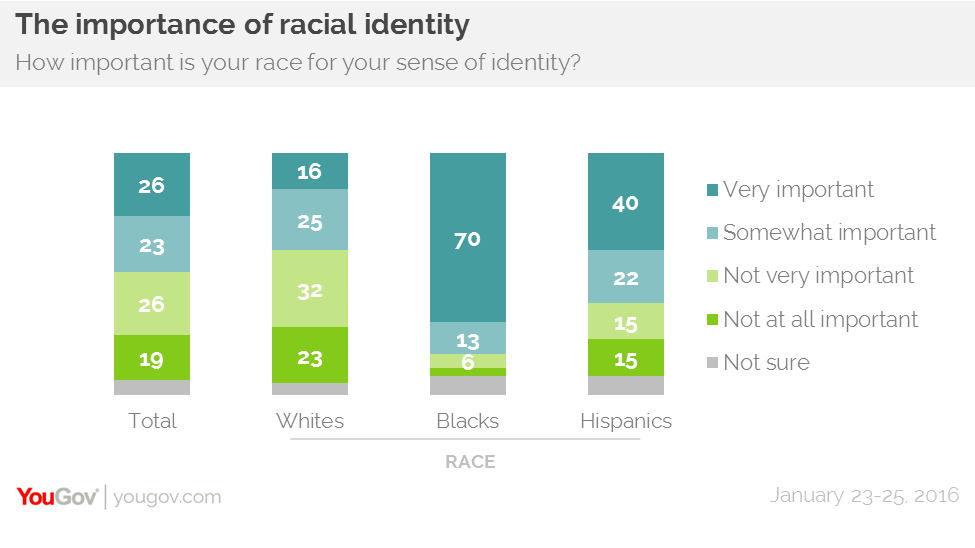
Maybe this is part of the reason many white people don’t understand where people of color are coming from?
Reference:
https://d25d2506sfb94s.cloudfront.net/cumulus_uploads/document/t5xd6b47t8/tabs_OP_Race_and_Class_20160125.pdf
Maybe this is part of the reason many white people don’t understand where people of color are coming from?
Reference:
https://d25d2506sfb94s.cloudfront.net/cumulus_uploads/document/t5xd6b47t8/tabs_OP_Race_and_Class_20160125.pdf
14. Clothing
Parents of children of color have to be careful how they dress their children. Dressing a black child in clothing with raccoons, alligators, monkeys, watermelons, or bananas is opening up that child to potential racial taunts and name calling. Dressing a Native American child in clothing with feathers or arrows or an Asian child in pandas is the same.
Parents of white kids don’t have to consider these things.
White friends, please take a look at the resources below to understand why I, many other white adoptive parents, and parents of color will not dress their children with these kinds of graphics. We do not want to open our children up to the possibility of being called horrid, racist names. And yes, it really does happen, and it happens often. I know black people who will not even eat watermelon in public!
Resources:
Racoon -
http://www.authentichistory.com/diversity/african/3-coon/1-history/index.html
http://www.rsdb.org/search/coon
Alligator -
http://www.authentichistory.com/diversity/african/3-coon/7-alligator/index.html
http://www.ferris.edu/htmls/news/jimcrow/question/may13/index.htm
Monkey (and by association bananas) -
http://www.authentichistory.com/diversity/african/3-coon/6-monkey/index.html
Watermelon -
http://www.theatlantic.com/national/archive/2014/12/how-watermelons-became-a-racist-trope/383529
15. Internal Bias
Most of us have internal biases that influence our snap impressions of different types of people.
It's what makes us think redheads are temperamental and blondes as flighty.
It's what makes us assume that a white woman with four or five kids is a middle class woman who loves kids and a black woman with the same amount of kids as dependent on government assistance.
It's what makes us think about a man taking advantage of his rights when we see white man carrying a gun but threatened when we see a black man with a gun.
It's what makes women cross the street when they see a group of teen boys walking toward them.
It's what makes us think that the group of white people protesting outside of a mosque are just impassioned people looking out for our nation but see a group of black people protesting outside of police station as thugs, hoodlums, and bums who need to get a job.
It's what makes us see an Asian high school kid as smart and a black kid as less than smart.
It's what makes us see the Hispanic family at Walmart as illegal aliens.
It's what makes a store employee follow a black person around the store to make sure that nothing is stolen.
It's what makes us see a teen black boy in a black hoodie as a thug instead of a kid walking home from the store.
These impressions may last a split second, and we correct them. They may completely form our opinion of a person or situation with no correction.
If you're interested in finding out what your internal biases are, you can take a test online.
Over the next several days, I’m going to highlight different aspects of life, from medical care to buying a car, that this kind of stereotyping impacts for people of color.
To give a very recent personal experience with the stereotyping of my young black daughter (KG), I took all three kids to the doctor for what I knew was pink eye in my white son. The PA that saw us confirmed I was right. We had all been sick off and on for close to a month. Most of us were on round two of colds. I half-jokingly asked the PA if she could prescribe enough eye drops to cover the whole family so we wouldn’t have to drag ourselves back out to the doctor again when we all got it, too. She paused for a second, looked at KG, and looked back at me with an almost exasperated look on her face. She said with a tone that matched her look, “You know Medicaid will cover the eye drops so you don’t have to worry about the cost.”
Subscribe to:
Posts (Atom)